Sunday, 24 June 2012

Find of the Week (14)

I tweeted yesterday that I found some interesting booty - a cannonball, a pair of ice skates and a WW1 bullet, inside a box. I forgot they had been stored in the basement, they were to form part of an exhibition earlier in the year but in the end they didn't make it into the display cabinets. You might wonder what a cannonball, pair of ice skates and WW1 bullet had in common, nothing, but as individual objects they represented visuals for the written exhibition boards. Finding the objects was an avoidance tactic. I was in the middle of writing a grant proposal and I needed distraction, I found it. I also found a cigarette packet and a small metal tin on my short wander round the basement. Short as in medium sized Carnegie library. The cigarettes were an empty packet of Kensitas extra size, it still had the little piece of silver foil on the inside and a very faint smell of tobacco. I also noticed some numbers faintly stamped on the bottom but I couldn't read them so I'm not sure what they represented. I think it dates back to the late 1940's, early 1950's.


The small  metal tin, Altoids. It sounds more like a disease or dietary straining disorder than a peppermint. I wonder if whoever smoked the cigarettes used the Altoids to mask the tobacco smell.


Wednesday, 26 October 2011

LGBT 3 - LGBTQ YA Fiction

In a previous post I wrote - Libraries have a duty to take reasonable steps to ensure equal access and equal service provision for all community/minority groups under their umbrella, they may not have an obligation to promote the service however there is a duty to provide resources.
The Scottish Library & Information Council (SLIC) established the Public Library Quality Improvement Matrix (PLQIM), a quality assurance tool which states:
Libraries must promote inclusion, equality and fairness and work positively with partners to facilitate communities of interest and encourage participation”.
The Chartered Institute of Library & Information Professionals (CILIP) begin their 'sexual orientation and libraries' ‘sexual orientation and libraries’ statement with:
Libraries exist to meet the information, lifelong learning and leisure needs of all sections of the community, whether heterosexual, bisexual, gay or transgender”.


When looking at LGBTQ YA fiction we must ensure we provide access to resources that are representative of LGBTQ youth today, to enable all to have positive experiences when sourcing reading material. It is very likely that LGBTQ youth make up a proportion of YA using both public and school libraries in the UK and further a field. 

The difficulty for librarians is trying to provide appropriate LGBTQ YA material when supplier selection lists aren’t adequate enough. CILIP state that “mainstream suppliers may hold only limited relevant titles, and therefore care should be taken to make use of wider resources available via specialist bookshops/suppliers”. I'll list some bookshops and publishers later in this post. Filters on educational or council servers don’t allow searching on specific words, file types or url’s, then asking to have them unblocked to be able to searc. Librarians may have to source material in their own time, not their employers. Yes, we all probably do this on a daily basis but if you take into account all the resources we have to source due to a lack of work resources, it leaves little time to give each subject a true representation within our libraries.

So, to find a list of LGBTQ YA fiction.


I’ve been amazed by just how much material is actually out there in relation to YA fiction, I’ve found some great book lists, reviews and blogs. Daisy Porter   is a public librarian who reviews LGBTQ YA fiction. Amanda Rudd is a sci-fi writer and crazed academic who has a list of LGBT YA fiction books. The Trevor Project have a great book and film resource which includes both fiction for LGBTQ youth and non-fiction resources on specific topics including mental illness and self harm. The American Library Association has Rainbow Books , a list released every January (since 2008) of LGBTQ books from birth to 18 years.You can even see the 2012 nominees on their blog.

If you're interested in the research side of LGBT provision then Elizabeth L. Chapman and Briony Birdi have written a report on attitudes to LGBT fiction for children and young people. To find a great list of resources on building collections, services to LGBTQ YA and other research, have a look at Teacher Librarian 2.0 for some great links.

I'm not a subject specialst in LGBTQ YA fiction therefore I searched and discovered two comprehensive LGBTQ ficiton lists, one from a librarian/researcher and the other from a LGBTQ YA author.

The list can be found on the right hand side under 'downloads' 


Searching through the lists and reading blogs and reviews some  authors of note:


If you are looking for publishers and bookshops supplying LGBTQ fiction the links below may help you:


If you are a school or public librarian and are aware of other fiction resources that I've clearly missed then please leave a comment below.
If you are a LGBTQ YA and have a favourite book please leave a comment.

Tuesday, 18 October 2011

LGBT 2 - 20 lesbian books on a shelf

20 Lesbian books.

How do you decide on a list of 20 lesbian fiction books? [ 20 that you’d like to see in public libraries]

This list is not a definitive guide to lesbian fiction, it has been put together to highlight the diverse collection of lesbian fiction that is available today, and as an aid to stock selection panels.

Firstly, getting the list of titles down to 20 is hard, deciding on a list that takes in all genres of lesbian writing, is hard. I am one librarian, one lesbian; my selection won’t suit all literary tastes or persuasions. I’m looking on bookcases, under tables, in the dusty recesses of my mind to remember all of the authors I have either read or have listed to read.

There are the classics, the books that will be gathering a thin layer of dust on any self-respecting lesbian’s bookcase. Alongside these will probably be the set of contemporary fiction must haves, and finally, the popular lesbian titles, the ones I often refer to as the chick lit* shelf fillers.
* Not intended to offend any author. The majority of these titles are constantly on  bestseller lists.

In no particular order -

The 20:


Tipping the Velvet by Sarah Waters

Dykes To Watch Out For by Alison Bechdel

Fall On Your Knees by Ann-Marie MacDonald

Curious Wine by Katherine V. Forrester

Landing by Emma Donoghue

Mind Games by Nancy M Griffis

Talon by J P Mercer

The Devil Inside by Ali Vali

The Color Purple by Alice Walker

The Night Watch by Sarah Waters

Lonely Hearts Club by Radclyffe

Tristian Book 1 –The Clinic by Cate Culpepper

Hunters Way by Gerri Hill

Stir Fry – Emma Donoghue

Safe Harbor by Radclyffe

Oranges Are Not The Only Fruit by Jeanette Winterston

Patience & Sarah by Isabel Miller

The Price of Salt by Patricia Highsmith

Fried Green Tomatoes At The Whistle Stop Café by Fannie Flagg

Essential Dykes to Watch Out For by Alison Bechdel


Amongst the books I’ve selected you’ll find crime, sci-fi, fantasy, graphic novel, drama and romance.

If you have a favourite lesbian novel that’s not mentioned then add a comment.


LIBRARIANS - take the challenge: how many of these are available in your area?


Next Blog Post- LGBT 3 - junior/teen/ya fiction -


LGBT 1 - the dormant research proposal

It's been a few years since I wrote my research proposal but I believe some of the references may still be relevant  when looking at LGBT fiction in public libraries. Libraries have a duty to take reasonable steps to ensure equal access and equal service provision for all community/minority groups under their umbrella, they may not have an obligation to promote the service however there is a duty to provide resources.

Public library services in Scotland are entirely the responsibility of local authorities which have a statutory duty to secure the provision of adequate library facilities for all persons resident in their area” 1


Scottish Libraries also have the Scottish Library & Information Council (SLIC) an independent advisory body whose members include all local authority‘s in Scotland. They established the Public Library Quality Improvement Matrix (PLQIM) 2 a quality assurance tool specially developed to support policies in areas such as health and regeneration. Within the document it recommends that public libraries;
  • Libraries must promote inclusion, equality and fairness and work positively with partners to facilitate communities of interest and encourage participation

This list is part of the bibliography I put together when I first started looking at LGBT provision in public libraries, something on the list might be of use:

Cook. J., 2005. Gay and Lesbian Librarians and the ‘need’ for GLBT Library Organizations: Ethical Questions, Professional Challenges, and Personal Dilemmas In and ‘Out’ of the workplace. Journal of Information Ethics 14 (2) pp32-49

Curry. A., 2005. If I ask will they answer? Evaluating public library reference services to gay and lesbian youth. Reference & User Services Quarterly 45 (1) pp65-75


Curry. A., 2000. Collection Management of gay/lesbian materials in the UK and Canada . LIBRI 50 (1) pp14-25

Goldthorp. J., 2007. Can Scottish public library services claim they are socially inclusive of all minority groups when lesbian fiction is still so inaccessible? Journal of Librarianship and Information Science 39 (4) pp 234-248

Greenblatt. E., 2003. Lesbian, Gay, Bisexual, Transgender Library Users: Overcoming the Myths. Colorado Libraries v29 (4) pp21-25

Joyce. S,L., 2000. Lesbian, gay, and bisexual library services: a review of the literature. Public Libraries 39 (5) pp 270-279

Norman. M.,1999. Out on Loan: a survey of the use and information needs of users of the Lesbian, Gay and Bisexual Collection of Brighton and Hove Libraries. Journal of Librarianship and Information Science 31 (4) pp188-196

O'Leary. M., 2005. Pink perceptions: the information needs of lesbian, gay, bisexual and transgender library users as perceived by public librarians and by the LGBT communities within Sheffield UK and Denver CO, USA [Online]. MA, University of Sheffield. Available online: http://dagda.shef.ac.uk/dissertations/2004-05/External/Oleary_Meagan_MALib.pdf

Potts. H., 2003. Searching the Database. A quick look at Amazon and two other online catalogues. Journal of homosexuality 45 (1) pp161-170

 Seborg. L., 2005. Sharing the Stories of the Gay, Lesbian, Bisexual and Transgender Community: Providing Library Services to the GLBT Patron. PNLA Quarterly 70 (1) pp15-17

Thomas.D., 2007. A Place on the Shelf. Library Journal 132 (8) pp40-43
Van Buskirk. J., 2005. Out of the Closet? Library Journal v130 p62


Sunday, 18 September 2011

Find of the Week (13)

This find of the week is courtesy of a donation handed into the local history department. An older gentleman handed the find into the library,he had little family and thought the libraries & museums department would be the best place for the find.
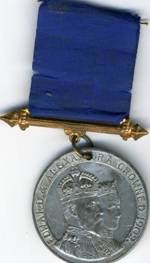
The find was inside an old metal tin, wrapped in paper and looked as though it hadn't been looked at for years. The find was a children's medal from 1902, it had the profiles of Edward the VII and Queen Alexandria on one side and the Dumbarton shield (elephant & castle) on the other side with the date 27th June 1902.  
The medal was to celebrate the coronation of Edward the VII in June 1902, however the original coronation date of 26th June had to be postponed as the King had appendicitis, the decision was taken by his consultants that 'at whatever inconvenience to the public, His Majesty's condition rendered an immediate operation necessary', the operation was successfully completed by Sir F. Treves.
In Dumbarton the town has started decorating buildings, setting gas illuminations and decorating homes with flags and bunting. The executive committee arranging the municipal celebrations had to cancel all celebrations including, the school choirs(over 1000 kids), maypole dancing, the regatta, the town procession and the firing of the royal salute.
The coronation was rescheduled and the King was crowned on the 9th of August 1902 at Westminster Abbey.
 In Dumbarton in the weeks leading up to the coronation many of the towns    residents were giving the thought of celebrating the cold shoulder. The town asked for subscriptions towards the funding of the coronation celebrations, the donations were slow in accumulating, however a total of £450 was reached. The town used the funds to put together a programme of festivities for the coronation. They included a religious service, competitions for vehicular and equestrian turnouts, firing of a royal salute, dancing, sports, fireworks and a bonfire.
The town again decorated households and businesses in flags and bunting, the towns bridge was decorated with streamers and the municipal buildings and burgh hall were decorated in flags, gold crowns and shields.
The highlight of the evening celebrations was the electric display at the Leven Shipyard, with ribbons and lights hanging from mast to mast at the quay side.

Thursday, 8 September 2011

Chloe's Chemoo Cows


Have you ever heard of Diffuse Intrinsic Pontine Glioma [DIPG]? No. Neither had I until last year. Chloe, to whom the website is dedicated, was diagnosed with DIPG late last summer.
I am honoured to have known Chloe who was courageous, bright, talented, charming and funny. Chloe touched the hearts of all who knew her, her smile could light up a room, she was surrounded by amazing young friends and a fantastic family.Chloe's zest for reading and her ability to make my niece smile, will always be my abiding memories.
Sadly, after fighting the tumour with all her might, she passed away on 16th June 2011. 
In honour of their very talented daughter, her parent Mark & Elaine have set up the charity and website   Chloe's Chemoo Cows  
Mark & Elaine never stopped searching for information on DIPG, and the information they gathered has been used in the creation of the website. There is an excellent explanation of DIPG for all to understand, including symptoms and treatments. 
At the heart of the website are the chemoo cows, each child at the Schiehallion, (Yorkhill Hospital, Glasgow) receiving chemotherapy treatment will receive a chemoo cow. The website is also packed full of fun things to do, colour in your chemoo cow, try a chemoo wordsearch or learn some cow jokes, its all on the website.   
To know that their are kids out there gaining a little comfort from Chemoo Cow is a fantastic legacy.

So, in honour of Chloe have a look at the website, try to remember those little Chemoo Cows, just incase, one day, you need to know or someone close to you needs to know information on DIPG.

Wednesday, 31 August 2011

tech

Found this http://youtu.be/x-9FaJPhFxQ it was uploaded in 2008, what would the figures be now? Just how dependent are we now on technology to live our daily lives. At the moment I've got the pc running, an external hardrive hooked up, my satellite tv recording programs, my smart phone lying by my side, a usb stick plugged in, a kindle beside my bed and I'm not a technolgy geek, in the gadget sense.
It's made me think about those  'when we were kids' posts, back in the days before the mobile phone, the modern pc and the games console. I used to remember the phone numbers of friends and family, when a red phone box was a life saver - now I know 2 numbers and the rest are stored on my smart phone, accessed at the touch of a button of flick of my thumb.To read, I picked up a book, magazine or newspaper, now I plug in a device, flick a switch and have constant news updates. To write to my friends was the only way of communicating long distance, now I text, use social media or email. So, technolgy has changed the way I work, socialise and communicate in 2011.....so what will be added to my collection of social gadgetry over the next few years.
For now, I'm going to turn off my pc, pick up a book and listen to the tick tock of my clock.

Tuesday, 26 July 2011

Find of the Week (12)

It's been a while since I added a 'find of the week'. Due to restructuring at work and preparing to move house my time to blog has been limited. However, I did find this little gem the other day.
So, how do you go to bed? Is it pj's, shorts, old t-shirt, nightie, naked?This piece from the Omaha Herald, reprinted in the local newspaper,tells the tale of an old maid and her bedtime routine.


Monday, 6 June 2011

New Job

First came the restructure, second came a very long job profile and third came the interview last Wednesday. The interview was in two parts, a PowerPoint on "my vision for my section of Arts & Heritage over the next 3 years" and then some good questions on increasing access to collections, team working,  promotion of service and improving access and provision of reference services. I enjoyed delivering the PowerPoint, I concentrated on:
Increasing engagement with the community
Improving awareness and access to collections
A Partnership apprach

So instead of Information Services Librarian its now Local History and Reference Librarian.

Friday, 7 January 2011

2011 - January

The working year began today. I've spent the past fortnight eating, drinking, reading and playing the occasional game of Guess Who.  
I opened outlook at 8.52 am, I thought people would be too busy over the holidays to send enquires, I couldn't have been more wrong. I was amazed not only by the amount of enquires but by the complexity of them. Thankfully the fight against the ever increasing inbox is now being fought jointly by me and my new secret weapon - Isabel the newly appointed Information Services Assistant. I'm not alone anymore.
The first project for this year is based on intergenerational learning and is funded by Museums and Galleries Scotland. 'Climbing Tress - The Census' will focus on working with Primary 5-7 pupils and older members of the community, we will be developing and delivering workshops to be used during school visits, a census pack for all local primary schools with links to the Curriculum for Excellence. The project will give children an understanding of what the census is and how it has developed since the 1840's. We will be bring the census to life by using local maps, valuation rolls, photographs and the census records of key local figures. The project will culminate in an open day during Scottish Local History week, which will include an exhibition within Dumbarton Library, family information sessions on Scotland's People and Ancestry, ensuring all generations of the family work together to search the resources for information on their family histories.
It's also another year of change, development and opportunity, the service is being restructured and the local studies/history section is now placed within the new Arts & Heritage department. The opportunities this presents are fantastic, to work with our very skilled and dedicated arts and museums team is fantastic.

Friday, 17 September 2010

Enquiry List

I mentioned in my last blog post – ‘every day I make someone smile’. Yes, I probably do, but it’s not down to telling them a good joke or offering them a chocolate, it’s about helping them find the answer to an enquiry. Like anyone in an information role I work through steps to ensure I can answer as accurately as possible. I ensure that I ask the right questions, use the right resources and have the tenacity to find the answer. I make the best use of the resources available to me and I am constantly sourcing additonal information to improve the service that I deliver.
The list below is a selection of some of the enquires I received this week in the local studies department;
  • American author emailing to find out when he can come in to collect digital copies of archive photographs of the local football teams
  •  TV researcher from a new family history programme following up earlier emails about local printing and dying industry – what examples of archives/photographs can we send for final selection
  • Where can I find plan/map of Dumbarton cemetery?
  • American lady enquiring about a Scottish Long Clock – just bought the old clock and the label of the back has a few words leading the enquirer to Dumbarton
  • Local walking group wanting to know if I present local history talks over the winter period
  • Do we hold copies of local newspapers for 1884 in particular July to October.
  • Another local authority contacting us on usage of certain archive photographs that we hold for a new exhibition, looking at reproduction costs / copyright
  • Information on a boat built by Denny the ‘Sir Walter Scott’ what information do we hold on its build. Also looking for a copy of the book ‘William Denny Shipbuilder’, he could source a copy for £250.00. (I could send him an inter-library loan for under a tenner. Or show him online where he could buy it for under twenty).
  • Man brought in an old bottle he fished out of the River Leven can we tell him anything about the local dairy company name engraved on the bottle.
  • Someone wondering why their great grandmother was born in the local Poor House.
  • Gentleman from New Zeland looking for information on the Nobles of Ardmore and Ardkinglass’ covering both the Kenny and Geils families. Including local maps and photographs where possible.
  • Council Legal Department asking for ownership details from valuation rolls from 1950’s, 60’s and 70’s.
  • Library Centenary Year – mug shots in local paper, staff want copies for archive and personal use.
This list does not constitute my whole working week, however it does represent how varied the enquires received can be.  

Wednesday, 1 September 2010

Inadequate - chartership

Do we all get a feeling of inadequacy at times, unless we happen to be Yoda?

I’ve realised that it’s now 12 months since I started my Chartership journey and I still feel rather perplexed by the whole process.
I’ve perused CILIP’s Chartership webpage, read the example submission, joined the JISC mailing lists, attended the portfolio building course, collated the information from personal to professional, included the wider context, dissected my service and filled several folders full of potential evidence. [remembering to breathe in and out]
Then when I think I’ve got the 1,000 words, the contents page devised and the evidence ear marked for final submission, I get that overpowering feeling that it’s just not good enough.
When I look at some of the exciting young librarians on Twitter, the work they do everyday to promote library and information services is fantastic. I often think that what I do doesn’t measure up….I’m not an advocate like Jo Alcock, Ian Clark , Bethan Ruddock and others.

I’m just the Local Studies Librarian for the fourth smallest local authority in Scotland. Nonetheless every day:


I can make someone smile, a genuine eye smile.
I make it easier for people to locate information.
I find that piece of information they have been searching years to find.
I can help find the last piece of someone’s puzzle.
I help people become familiar with their heritage.
I can correct someone’s assumptions.
I can listen to someone tell me a little about themselves, just because I’m there.
I find things every day that make we want to cry.
I find things every day that make we want to smile.
I can spend days on just one enquiry, relate that to a statistic.
I can teach people to locate information for themselves.
I make researchers jobs easier.
I geek my job.


If you found the above list rudimentary then I’m sorry but at times it’s the simple things that matter. If you want to read the in-depth version then I’ll post you the 2, A4 folders full of reflections over the past year. I could have typed out all the facets of my job but I’m afraid my job description is rather long.
I think these are the things I’ve found frustrating not being able to mention during Chartership, the passion as individuals we hold for our jobs. I adore what I do, yes it’s an operational post, I have great colleagues [not quite yoda's yet!] who are great strategic thinkers, who have more time and energy to spend on the strategy but I think you need the ying and yang in all organisations to bring out the best in everyone.
So, hopefully come October I’ll put my submission for Chartership in the post and hope that the information I’ve included passes the board. Yes, getting the nod does matter, I’ve spent a long time getting the post-grad and writing the Chartership portfolio.

Monday, 2 August 2010

Find of the Week (11)

I’ve spent a fair bit of time over the past week researching the 1/9th [Dumbartonshire] Argyll & Sutherland Highlanders during the First World War. It’s been fascinating and harrowing. The enquirers were very specific about the information they required, which meant a fair bit of in-depth reading and hunting through the archives. In Dumbarton we hold a number of archives on the Battalion and each piece was read in detail this looking for information on the battalion during May 1915, when they were fighting in Ypres, Belgium.

The information I’ve found has given me an insight into the war experiences of these men during the First World War. I’ve had the opportunity to read the detailed muster roll of the men enlisting, many lying about their age to join under the guise of being 18 years old. I identified one young man who signed up at fourteen and never came back. I sat wondering how many of these men [boys] didn’t return home to Dumbarton and the surrounding areas. When you sit looking at a document hand written in 1914 it humbles you, how quickly these young men signed up and were sent to the front.
The 1/9th were involved in the second battle of Ypres, May,1915 a hard fought battle with heavy artillery fire and the use of chlorine gas by the Germans. To read more on the accounts of the battle follow these links –

http://www.firstworldwar.com/battles/ypres2.htm
http://en.wikipedia.org/wiki/Second_Battle_of_Ypres
http://www.users.globalnet.co.uk/~dccfarr/summary.htm
http://www.argylls.co.uk/

The most poignant accounts I found whilst searching the archives weren't the official minute books and documents but letters printed in the local newspaper. Ordinary soldiers and ranking officers writing from the front line. I want to share some of the testimonies [those not censored during the war] I’ve been reading that describe the fighting in Ypres in May 1915.


Victim of Gas Attack:

I am suffering from the effects of asphyxiating gas. Fortunately I managed to fight the gas determinedly. We were not long in bed (2a.m. Monday) when I was warned to get ready, and looking out of the little cave I could see a dense fog or mist all round. It seemed hopeless to escape from the effects. I had not a respirator, so took the end of my blanket and filled it with clay and, closing my nose, breathed though the blanket and clay. All around there was a prefect storm of shells and shrapnel. The gas came from the shells, and you could see them explode and emit a great browney-grey cloud. Imagine me squatting in a little hole in the ground fighting for life

Dumbartonshire Territorial Rank: Private:

I am still in the land of the living. We are still in the trenches. We have never been out of them since we came up a month ago. We have had a terrible time of it this week, but it seems to be quieting down again. I must have born under a very lucky star to have come out of the big battle, which lasted for five days, starting last Saturday morning. The shells were falling round us like hail, and we had to cross in the thick of them to support the 80th brigade, who were lying on our left. We have lost very heavily.”

Dumbartonshire Territorial Rank: Lance Corporal:

We had to cross an open field to get to the trenches. When crossing it the fun began. The Germans sent over shrapnel “zipbangs” and “Jack Johnsons”[heavy artillery shells] such as never was seen since the war began. We got orders to lie down in an old trench about 12 noo. At that time we had an officer killed and several men wounded.”

Dumbartonshire Territorial Rank: Sergeant

It is the first big fight the territorial’s have taken part in. There were 45 in the platoon when we made the charge and only three reached the trench, the others being knocked out on the way. We were mowed down like hay. Our colonel was killed and as far as I know nearly all our lieutenants were wounded or killed.”

There is a war memorial in Ypres the Menin Gate  ,where amongst the names are those from the 1/9th Argyll & Sutherland Highlanders who fell in May 1915.

Thursday, 24 June 2010

6 months

I just put the kettle on and already it's June. I can remember starting my new job, standing in the kitchen with its blue laminate floor, making tea. Flicking the switch, to boil the water, to wet the teabag, stir in the milk and drink. I couldn't possibly count the number of cups of tea and coffee i've drank over the past 6 months but its a lot (at a guess 720). The tea gives me a minute to relax, no thinking, searching or talking.
Aside from the tea I've spent six months learning from one of the best local history librarians in Scotland, Graham Hopner. It has truly been an honour and an education working with Graham. I wish he wasn't retiring tomorrow, I still have so much to learn from him. The history is there, the records, cuttings, books but it's the life that Graham breathes into each piece of history that makes the understanding all the easier.
Looking back over the months I've used Wordle to devise a word cloud of the enquires and documents I've worked on.


Looking through my files the first email enquiry I received was from Glasgow Museums looking for information on Dumbarton Art School. 
The school has it's origins within Dumbarton Burgh Academy; it was set up in the attic flat of the academy in 1882. The school was begun after a meeting on the 21st Nov 1882 of interested parties to create an art school, initiated by Mr. William Denny of the Leven Shipyard. The school was only used for a month in the attic flat of the Burgh Academy as a fire destroyed the building after the school started operating. A plumber carelessly knocked over a candle whilst installing some pipe work.The Dumbarton Burgh Academy was rebuilt in 1884 and the School of Art moved into more spacious accommodation, the cost of which was £1000 pounds provided by Mr. William Denny and friends. Early in the 20th Century the school was named the Dumbarton School of Science and Art.It wasn't the history of the school that intested me the most but a photograph of the interior. It has became an iconic image for me.


Dumbarton Art School © West Dunbartonshire Libraries

Wednesday, 9 June 2010

Day 3 - retail therapy?

Day three of the CILIPS annual conference began for me with a presentation by Fiona Edwards of Opening the Book. The theme for the presentation ‘Turning Browsers into Borrowers: adapting retail techniques for the library’. As you can imagine it was a packed session in the Blythswood Room of the Mitchell Library. Fiona gave us cause for thought with her presentation on improving the browsing/choosing experience of our library patrons, customers, users, visitors. The retail aspect of the presentation focused on bookshops in particular Waterstones, which to be fair still have a hold on the UK High Street book market. Fiona briefed us on where bookshops get it right, mostly through their promotions such as multi buys, bestsellers, top ten and book of the month displays. As library services we don’t have the stock budgets to produce these large scale displays or keep these displays adequately stocked. So, how do we improve our services and turn browsers into borrowers? Fiona gives us some tips:
  • Quick Choice – tempts the borrower, makes choice easier
  • Recommendations – whether it be reader to reader or staff recommends  
  • Face-on Displays – in fiction and non-fiction areas, helps to brand non-fiction areas
As mentioned Fiona is from Opening the Book, who provide online library training ‘frontline’ for library staff. The enthusiasm of staff that have completed the course was evident today listening to Elizabeth Farr and Liz Moffat from Stirling Libraries. Their session ‘Marketing Books to readers in Stirling’ described their approach to reader development and marketing after completing the frontline training course. They explained how rewriting their policies on reader development and marketing came from re-evaluating after the training. Through identifying their strengths and weaknesses they have several new initiatives, one being ensuring they have 2 new promotions each month. They have also taken the approach of branding their libraries, having not only a marketing team but a design team who work in conjunction with Stirling Councils corporate communication team, which I thought was an excellent idea.Tips from Liz & Elizabeth:
  • Talk to your borrowers
  • Just do it! Try things, if it doesn't work drop it
  • Remember your 'loss leaders'
  • Evaluate constantly
  • Keep information positive 
  • Look outside your comfort zone for stock promotions
I enjoyed the session however as a past employee of Waterstones and a current public librarian I also felt exasperated by it. Only over the past couple of years it seems are public libraries looking at retail techniques that have been about for decades, longer even (I can remember one Scottish authority visiting Waterstones in the late 90’s to discuss with us how to promote stock to both adult and junior borrowers). Although comments heard after the presentation concentrated on the realisation that the majority of us use or have used the techniques mentioned above. So, have we become complacent in our approach to continuous best practice in developing the reading experience and marketing of books? We provide excellent services; we have large diverse ranges of stock, we have fantastic initiatives – too many to mention SO are we just really bad at marketing book stock? Do we need to be making more regular visits to the High St for inspiration? Should I be calling Mary Portas for advice? Have we spent far too much time over the past few years concentrating on our learning provision and lifelong learning initiatives and not enough time on stock promotions and reader experience? As librarians we should not underestimate what we can learn from the retail sector, after all Waterstones is still fighting and winning its retail battle. Many will argue that the retail bookshops learned from librarians, maybe so and it’s a large maybe, but they manage to keep selling books, our issues are dipping. At the end of the day bookshops need to make money and we need borrowers and issues, its cold hard profit which ever way you dress it. If the retail sector holds the key to falling issues and active borrower statistics then I’m all for getting a copy of the key.

Tuesday, 1 June 2010

fbook

I’m not addicted but I do spend time on social networks. I wondered today, do I actually learn anything whilst on Fbook? I browse, flick and glimpse my way though other peoples updates, I learn about birthdays, babies, holidays, nights out, politics, books, films and music. Great, but can I use any of this in everyday life? Will any of it ever be a golden nugget of information that I’ll one day get out and polish? I looked back at the last five days of fbook updates and found; one new web site, airline charges, some DIY tips and some seventies TV nostalgia.

Nuggets:
Ryanair will charge you £40 for being 3 minutes late for a flight.
The film 'The Bands Visit' is recommended.
Need a t-shirt http://www.cuteweethings.com.au/
That a hangover can be induced by red bull and monster just as much as it can be with alcohol.
You can power wash wooden decking.
Dr. Peter Reid became a professor.
One of my best mates completed her 300th geocache today.
Your hungover brain can find animal shapes in landscape photographs (lion below)
It was confirmed that Gary Coleman had died, the actor from Diff'rent Strokes… ‘what you talking about willis’.
Twiki (pronounced twee-kee) was the best thing in Buck Rogers! Mel Blanc (Bugs Bunny et al) was the voice.
The Lions Head

©Sharon Donnelly

Sunday, 30 May 2010

Find of the Week (10)

This find of the week came from a tweet; angefitzpatrick sent links to two articles on trident, a reflection of life on board and the future of trident under a coalition government . The Trident home, Faslane Naval Base, Gare Loch, is just outside my boundary line but these are interesting article, which I'll pass on to the  reference librarian in Helensburgh. The tweet led me to ask, had any of the Dumbarton shipbuilders built submarines? I know of famous boats built down this end of the water, The Cutty Sark, The Shamrock II & III, The Rob Roy. However, I’d never had cause to wonder if they built submarines. A seach of resources held in the library resulted in an answer.
Submarines were built by Denny during the First World War, the order being placed verbally. Denny’s were new to submarine building so the admiralty aided in the plans and rough castings for the hulls. They were known as ‘E’ type submarines and were the standard design at the outbreak of the war. The first two completed by Denny’s were the E.55 and E.56 built in 1916. The final cost of the submarines was £144,600 with Denny &Co’s profit being £2,314. The price per ton was £10.98. They remained navy vessels until 1922 and 1923 respectively when they were sold. The last E type that Denny’s built was the E.52 in 1917, it left Denny’s March 1917. The final price was £70,500 with Denny & Co profiting by £876. The E.52 submarine was sold for scrapping in 1921 and used to fill a mud bank on the River Dart in 1923.
The final submarine that the Denny yard built was the ‘L’ class, L.54. This submarine replaced the older ‘E’ class due to design and armament changes. Its original deliver date was March 1918, however work came to a stop during the build and she was completed circa 1919. The total cost of the build was £124,911 with Denny receiving about a 10% profit. She was sold for scrap in 1939 just before the outbreak of war.

©West Dunbartonshire Libaries


Shaving, remember the adverts in the 80's for Remington fronted by Victor Kiam ? Or Gillette  using the silky smooth, Federer, Henry and Woods. It's all come a long way since this little advert, no million dollar stars just 'four good points'.


Sunday, 16 May 2010

Move

I've moved. I haven't moved far, but the views are different and the air is fresh. I've taken five days to move fifty feet, its been a slow process and I'm still not finished. I started the move on Tuesday at 9.01am, I didn't even have my morning coffee.  I had a plan, a visual one in my head, I could tweak and adjust as I went along. I piled books on and under tables, the bookcases being easier to move empty! I even had a dedicated removals volunteer who helped me move cases and place books back on shelves. By 11am I had moved the bookcases and identified some new map tables. Coffee. Placed the remainder of the books back on the bookcases, taking a little longer than necessary when two piles fell over, scattering dewey all over the floor. The afternoon meant moving the heavy equipment, a 2 person job. We moved the microfiche and microfilm machines form one room to another and rejoiced that they fit in their allocated spot. First day of move complete.
Wednesday, day off. So, Thursday morning, time to move the desks and navigate the stairs from the basement. It looked really easy, wrong!  We got stuck twice, jammed fingers once, swore several times. It's amazing how many positions the human body can achieve when trying to squeeze a desk up through a narrowing turning stairwell. Desks done. Publications group meeting, short. Friday, my mantra for the day was, 'email Irene', should have worn an elastic band or wrote it on my hand, forgot to email. So, not sure when my PC can be moved. Saturday, managed to enjoy the view from the window. Oh, my view, a roundabout, the sheriff court and some lovely green trees. After working in a basement with artifical light and no air, I'm enjoying the change.

Wednesday, 5 May 2010

Find of the Week (9)

This ‘find of the week’ deals with the library itself, well the 1922 catalogue. I had spent an afternoon looking for some old photographs and came across a set of the library interior from the 1950’s. The first photograph that caught my eye was one of the large indicator panels. The panels were located where our learning suite and reference sections are now situated. The large panels held records for each book in the library, they had blue and red indicators to inform customers which books were in stock or on loan. The boards made it look more like a ticket office than a library, due to the fact that all of the stock was located behind the counter on stacks.
©West Dunbartonshire Libraries

I don’t have the actual catalogues from the 1950’s but I do have the 1922 edition where the arrangement of the catalogue was known as the ‘dictionary catalogue’. This edition of the catalogue had 7,987 entries. Each book was entered in alphabetical sequence under the author’s name, its subject, and, where distinctive its title. Fiction however was only added under the author.
An example from the catalogue;
Austen (Jane) – Persuasion …….E.W……F2277
Australia. Hill (R. and F.) What we saw in Australia, 1875……B1979
The E.W. after the Austen title is an abbreviation for Eminent Women Series and the number before each book number is one of the seven main classes;


A – Philosophy and Theology
B – History, Travel and Biography
C – Law, Politics and Economics
D – Science and Art
E – Poetry & Drama
F – Prose Fiction
G- Language and Literary Miscellany

The catalogue also had 25 abbreviations listed and a separate section at the back for the local collection. The actual book itself is bound in hardback and fits the hand, a little like a modern e-reader, nice size. The interest for me though isn’t the actual arrangement of the catalogue but the ‘local studies’ collection mentioned within. I’m sure some of the local studies books I use as reference tools, are the ones mentioned in this catalogue. Thankfully due to these titles being closed access they have been preserved well.