Showing posts with label findoftheweek. Show all posts

Sunday, 24 June 2012

Find of the Week (14)

I tweeted yesterday that I found some interesting booty - a cannonball, a pair of ice skates and a WW1 bullet, inside a box. I forgot they had been stored in the basement, they were to form part of an exhibition earlier in the year but in the end they didn't make it into the display cabinets. You might wonder what a cannonball, pair of ice skates and WW1 bullet had in common, nothing, but as individual objects they represented visuals for the written exhibition boards. Finding the objects was an avoidance tactic. I was in the middle of writing a grant proposal and I needed distraction, I found it. I also found a cigarette packet and a small metal tin on my short wander round the basement. Short as in medium sized Carnegie library. The cigarettes were an empty packet of Kensitas extra size, it still had the little piece of silver foil on the inside and a very faint smell of tobacco. I also noticed some numbers faintly stamped on the bottom but I couldn't read them so I'm not sure what they represented. I think it dates back to the late 1940's, early 1950's.


The small  metal tin, Altoids. It sounds more like a disease or dietary straining disorder than a peppermint. I wonder if whoever smoked the cigarettes used the Altoids to mask the tobacco smell.


Sunday, 18 September 2011

Find of the Week (13)

This find of the week is courtesy of a donation handed into the local history department. An older gentleman handed the find into the library,he had little family and thought the libraries & museums department would be the best place for the find.
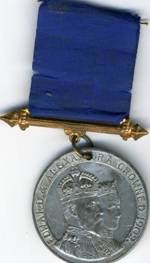
The find was inside an old metal tin, wrapped in paper and looked as though it hadn't been looked at for years. The find was a children's medal from 1902, it had the profiles of Edward the VII and Queen Alexandria on one side and the Dumbarton shield (elephant & castle) on the other side with the date 27th June 1902.  
The medal was to celebrate the coronation of Edward the VII in June 1902, however the original coronation date of 26th June had to be postponed as the King had appendicitis, the decision was taken by his consultants that 'at whatever inconvenience to the public, His Majesty's condition rendered an immediate operation necessary', the operation was successfully completed by Sir F. Treves.
In Dumbarton the town has started decorating buildings, setting gas illuminations and decorating homes with flags and bunting. The executive committee arranging the municipal celebrations had to cancel all celebrations including, the school choirs(over 1000 kids), maypole dancing, the regatta, the town procession and the firing of the royal salute.
The coronation was rescheduled and the King was crowned on the 9th of August 1902 at Westminster Abbey.
 In Dumbarton in the weeks leading up to the coronation many of the towns    residents were giving the thought of celebrating the cold shoulder. The town asked for subscriptions towards the funding of the coronation celebrations, the donations were slow in accumulating, however a total of £450 was reached. The town used the funds to put together a programme of festivities for the coronation. They included a religious service, competitions for vehicular and equestrian turnouts, firing of a royal salute, dancing, sports, fireworks and a bonfire.
The town again decorated households and businesses in flags and bunting, the towns bridge was decorated with streamers and the municipal buildings and burgh hall were decorated in flags, gold crowns and shields.
The highlight of the evening celebrations was the electric display at the Leven Shipyard, with ribbons and lights hanging from mast to mast at the quay side.

Monday, 2 August 2010

Find of the Week (11)

I’ve spent a fair bit of time over the past week researching the 1/9th [Dumbartonshire] Argyll & Sutherland Highlanders during the First World War. It’s been fascinating and harrowing. The enquirers were very specific about the information they required, which meant a fair bit of in-depth reading and hunting through the archives. In Dumbarton we hold a number of archives on the Battalion and each piece was read in detail this looking for information on the battalion during May 1915, when they were fighting in Ypres, Belgium.

The information I’ve found has given me an insight into the war experiences of these men during the First World War. I’ve had the opportunity to read the detailed muster roll of the men enlisting, many lying about their age to join under the guise of being 18 years old. I identified one young man who signed up at fourteen and never came back. I sat wondering how many of these men [boys] didn’t return home to Dumbarton and the surrounding areas. When you sit looking at a document hand written in 1914 it humbles you, how quickly these young men signed up and were sent to the front.
The 1/9th were involved in the second battle of Ypres, May,1915 a hard fought battle with heavy artillery fire and the use of chlorine gas by the Germans. To read more on the accounts of the battle follow these links –

http://www.firstworldwar.com/battles/ypres2.htm
http://en.wikipedia.org/wiki/Second_Battle_of_Ypres
http://www.users.globalnet.co.uk/~dccfarr/summary.htm
http://www.argylls.co.uk/

The most poignant accounts I found whilst searching the archives weren't the official minute books and documents but letters printed in the local newspaper. Ordinary soldiers and ranking officers writing from the front line. I want to share some of the testimonies [those not censored during the war] I’ve been reading that describe the fighting in Ypres in May 1915.


Victim of Gas Attack:

“I am suffering from the effects of asphyxiating gas. Fortunately I managed to fight the gas determinedly. We were not long in bed (2a.m. Monday) when I was warned to get ready, and looking out of the little cave I could see a dense fog or mist all round. It seemed hopeless to escape from the effects. I had not a respirator, so took the end of my blanket and filled it with clay and, closing my nose, breathed though the blanket and clay. All around there was a prefect storm of shells and shrapnel. The gas came from the shells, and you could see them explode and emit a great browney-grey cloud. Imagine me squatting in a little hole in the ground fighting for life”

Dumbartonshire Territorial Rank: Private:

“I am still in the land of the living. We are still in the trenches. We have never been out of them since we came up a month ago. We have had a terrible time of it this week, but it seems to be quieting down again. I must have born under a very lucky star to have come out of the big battle, which lasted for five days, starting last Saturday morning. The shells were falling round us like hail, and we had to cross in the thick of them to support the 80th brigade, who were lying on our left. We have lost very heavily.”

Dumbartonshire Territorial Rank: Lance Corporal:

“We had to cross an open field to get to the trenches. When crossing it the fun began. The Germans sent over shrapnel “zipbangs” and “Jack Johnsons”[heavy artillery shells] such as never was seen since the war began. We got orders to lie down in an old trench about 12 noo. At that time we had an officer killed and several men wounded.”

Dumbartonshire Territorial Rank: Sergeant

“It is the first big fight the territorial’s have taken part in. There were 45 in the platoon when we made the charge and only three reached the trench, the others being knocked out on the way. We were mowed down like hay. Our colonel was killed and as far as I know nearly all our lieutenants were wounded or killed.”

There is a war memorial in Ypres the Menin Gate  ,where amongst the names are those from the 1/9th Argyll & Sutherland Highlanders who fell in May 1915.

Sunday, 30 May 2010

Find of the Week (10)

This find of the week came from a tweet; angefitzpatrick sent links to two articles on trident, a reflection of life on board and the future of trident under a coalition government . The Trident home, Faslane Naval Base, Gare Loch, is just outside my boundary line but these are interesting article, which I'll pass on to the  reference librarian in Helensburgh. The tweet led me to ask, had any of the Dumbarton shipbuilders built submarines? I know of famous boats built down this end of the water, The Cutty Sark, The Shamrock II & III, The Rob Roy. However, I’d never had cause to wonder if they built submarines. A seach of resources held in the library resulted in an answer.
Submarines were built by Denny during the First World War, the order being placed verbally. Denny’s were new to submarine building so the admiralty aided in the plans and rough castings for the hulls. They were known as ‘E’ type submarines and were the standard design at the outbreak of the war. The first two completed by Denny’s were the E.55 and E.56 built in 1916. The final cost of the submarines was £144,600 with Denny &Co’s profit being £2,314. The price per ton was £10.98. They remained navy vessels until 1922 and 1923 respectively when they were sold. The last E type that Denny’s built was the E.52 in 1917, it left Denny’s March 1917. The final price was £70,500 with Denny & Co profiting by £876. The E.52 submarine was sold for scrapping in 1921 and used to fill a mud bank on the River Dart in 1923.
The final submarine that the Denny yard built was the ‘L’ class, L.54. This submarine replaced the older ‘E’ class due to design and armament changes. Its original deliver date was March 1918, however work came to a stop during the build and she was completed circa 1919. The total cost of the build was £124,911 with Denny receiving about a 10% profit. She was sold for scrap in 1939 just before the outbreak of war.

©West Dunbartonshire Libaries


Shaving, remember the adverts in the 80's for Remington fronted by Victor Kiam ? Or Gillette  using the silky smooth, Federer, Henry and Woods. It's all come a long way since this little advert, no million dollar stars just 'four good points'.


Wednesday, 5 May 2010

Find of the Week (9)

This ‘find of the week’ deals with the library itself, well the 1922 catalogue. I had spent an afternoon looking for some old photographs and came across a set of the library interior from the 1950’s. The first photograph that caught my eye was one of the large indicator panels. The panels were located where our learning suite and reference sections are now situated. The large panels held records for each book in the library, they had blue and red indicators to inform customers which books were in stock or on loan. The boards made it look more like a ticket office than a library, due to the fact that all of the stock was located behind the counter on stacks.
©West Dunbartonshire Libraries

I don’t have the actual catalogues from the 1950’s but I do have the 1922 edition where the arrangement of the catalogue was known as the ‘dictionary catalogue’. This edition of the catalogue had 7,987 entries. Each book was entered in alphabetical sequence under the author’s name, its subject, and, where distinctive its title. Fiction however was only added under the author.
An example from the catalogue;
Austen (Jane) – Persuasion …….E.W……F2277
Australia. Hill (R. and F.) What we saw in Australia, 1875……B1979
The E.W. after the Austen title is an abbreviation for Eminent Women Series and the number before each book number is one of the seven main classes;


A – Philosophy and Theology
B – History, Travel and Biography
C – Law, Politics and Economics
D – Science and Art
E – Poetry & Drama
F – Prose Fiction
G- Language and Literary Miscellany

The catalogue also had 25 abbreviations listed and a separate section at the back for the local collection. The actual book itself is bound in hardback and fits the hand, a little like a modern e-reader, nice size. The interest for me though isn’t the actual arrangement of the catalogue but the ‘local studies’ collection mentioned within. I’m sure some of the local studies books I use as reference tools, are the ones mentioned in this catalogue. Thankfully due to these titles being closed access they have been preserved well.


Wednesday, 21 April 2010

Find of the Week (8)

Whilst listening to and reading about the debates surrounding the forthcoming General Election, I thought I’d travel back to the 1910 elections. My interest stems from being the local history librarian and a constituent. The first election of 1910 was held from January 15th to February 10th, the votes counted, a hung parliament was announced with both the Liberals and Conservatives sharing the spoils. The conservatives racked in the most votes however Asquith’s Liberals has 2 additional seats. To resolve this situation an additional election was held in December between the 3rd and 19th , at which the Liberals formed a Parliament with the aid of the Irish Nationals. You knew that already, right?!

In West Dunbartonshire the contest was between the Liberal candidate Mr. James Dundas White and Colonel Henry Brock, Conservative. At previous elections in the county, the Conservatives had taken the seat. This was not to happen in 1910, when the liberals snatched a victory by 1033 votes. The second election in December had two new candidates, but a similar result. Standing for the Liberal Party, Mr. Arthur Acland Allen and for the Conservatives Mr.William Thomas Shaw. The Liberals again won the seat by 1312 votes.
I spent some time trawling though the local newspapers during the election months and I found that the local papers were favouring the Liberal candidate. Comparing the characters of both men in the run up to the polling days. However the funniest thing I found during my search was the following advertisement.

The advertisement is self explanatory; however my interest was on the word ‘patriotic’. Did the owner of the store call the corset the ‘patriotic corset’? If so, was he/she a Liberal or Conservative supporter? If the owner was a Liberal supporter then he/she must have known that Mr.Asquith was apposed to the women’s suffragette movement. How could any decent young woman of her time have bought a corset from a man who supported the Liberals? They might not have had the vote but they could have voted with their wallets.  However, to be fair,other political parties were apposed to women gaining the vote and not many women had their own wallets let alone a disposable income. Maybe I’m just thinking a little too much about a simple advertisement campaign.

Tuesday, 6 April 2010

Find of the Week (7.1)

I arrived back at my desk after Easter, silently placing a bet as to how many emails I'd have in my inbox. I skimmed headings and authors in no logical order, until one caught my eye. Mike Davis from Helensburgh Library had replied to an email I sent him before the holidays. I'd sent him a query asking if he had an image of Eunice Murray and he came up trumps. Due to local council boundary changes, much of the information on Eunice Murray is held by Helensburgh. I was excited reading Mike's email and very eager to open the attached .jpg. Mike mentioned having coffee the next time I'm through in Helensburgh, I think I'll be buying!
I had certain images in my head as to how Eunice would look, they were all lost the moment I opened the .jpg. For those interested here is the picture of Eunice Murray, sister, suffagette, parliamentary candidate and councillor.


Courtesy of Mike Davis, Librarian, Helensburgh


Monday, 22 March 2010

Find of the Week (7)

This find came from an a.s.a.p email sent by my Head of Service. The Council’s Public Relations Officer needed historical information on elections and voting in the area, specifically early voting and suffragettes. The research has been done and the information handed to PR. The find for me was exploring a women’s life, her work, writings and politics and the possible inequality of women’s heritage and archives stored within the department.

The woman was Eunice Guthrie Murray – b. 1878, d. 1960. She lived her life in Cardross, a small village near Dumbarton. She joined the suffragette movement in 1908 by becoming a member of the Women’s Freedom League (WFL) after becoming disheartened by the hostility to suffragettes in her area. By 1913 she had became president of the Glasgow branch and later Scottish Council of the WFL. She spoke out throughout her time in the suffragette movement and was arrested in London for persisting in an attempt to address a meeting from the steps of Downing Street to the Horse Guards Parade. The suffragettes went to many lengths to have their voices heard, as the well documented accounts confirm, such as Emily Wilding Davison. However Ms Murray disagreed with arson which had been used throughout the country to publicise the campaign.


She stood for the Glasgow Bridgeton seat at the 1918 elections, at the time she is stated as having said she had a ‘good deal of encouragement from both men and women’, however at the count she only received 1000 votes. This did not deter her and in 1919 she became a councillor in the Dunbartonshire area, she was also awarded the M.B.E in 1945. Ms Murray wrote throughout her life from early pamphlets for the suffragette movement to books on social history, in particular women’s history. From her collection of writings two stand out ‘Scottish Women of a Bygone Age’ and ‘A Gallery of Scottish women’.


Ms Murray was quoted in 1947; “Women have a two-fold calling, for not only are we as wives and mothers the guardians of the future, but we are also the custodians of the past,” (Scottish Homespun 1947) I’ll take the custodians of the past, as for the first part, I’m an Aunt not a Mother. As a local history librarian however I do believe I am now a custodian of my authority’s archives and related history. All of the custodians before me have been men, a long line of them. As librarians, each has brought new meaning to the collection and has specialized in specific areas. My main focus this past fortnight has been on the historical development of women in the area. I couldn’t find a great deal within the overall collection, even within the archive. However when you dig deep and spend time just researching and reading you start to find little things that could have been added to cuttings files or catalogued in the archive. We had a very brief outline of Ms Murray in the library; however with a little detective work on the old newspapers, it was relatively easy to find information. The question remains as to why until now is it not documented. Ms Murray was not only a woman but the first Scottish women to stand for a parliamentary seat, a local councillor and local author. My mission now is to focus on the Herstory of the area, something that is well overdue. What of the notable women in the 17th and 18th century, what of the women who worked in the whiskey bond or the wives of the shipbuilders, what social history is out there that we haven’t documented and is right in front of our eyes. It’s a very steep mountain to climb but one I am sure will pose a challenge for a few years. I have to place my feet firmly under the table and establish my knowledge on the area, then piece by piece interweave the women of the area into the herstory.

Sunday, 7 March 2010

Find of the Week (6)

The ceilings been painted and the lighting has been upgraded but that doesn’t stop us from bumping into desks. Near the back of the basement we have a desk full of donated material needing catalogued and preserved. One stack had a resemblance to the Torre pendente di Pisa, until about 4pm on Friday. That is until it all came tumbling down. I’m sure on Monday several hours will be spent sorting the materials and trying to assign ownership to some. This minor calamity led to the next find of the week, a small book of poetry by Mrs. C Campbell, a Dumbarton woman.

Mrs. Campbell was born in Alexandria, Dumbartonshire, in 1844, the daughter of a highly respected cooper. Mrs. Campbell moved to the nearby town of Dumbarton upon her marriage to Mr. Campbell. She began writing poetry at the age of 13 and wrote throughout her life. Mrs. Campbell’s poetry was featured in the Dumbarton Herald until her death in 1906, Donald McLeod a local historian and president of the Burns Club wrote the introduction/dedication to Mrs. Campbell’s book. In total thirty five poems are contained in the small volume, it’s bound in red leather and published by McNaughtan & Sinclair, Glasgow. I’ve enjoyed reading them all over the weekend, particularly her advice on marriage, the death of her dog, the changing of seasons and a particularly bad winter in 1895.
There are many of the poems I could add here but I’ve chosen ‘wee jenny’. The portrayal of Jenny by  Mrs. Campbell  is amusing. The poem is littered slightly with old Scots dialect :

wee jenny

To me wee Jenny's blithe and sweet,
I like tae hear her wee bit feet
Toddlin' oot an toddlin' in ;
I like tae hear her try and sing,
She does her best tae please us a',
But Jenny canna sing ava'.
Her little tale she tells in glee,
A' thochts and things she speirs at me;
And a'e thing Jenny likes tae ken,
Is when the pay-day, comes again;
Then will I get a ha'penny, maw?
And gang tae Jeanie's for a draw?
Yes, Jenny, that you'll sharely get;
Well, maw, you'll mind and no forget,
For Jeanie has long farthing stocks,
She's blue and yellow sugar rock,
She's sugar men and ladies tae,
I saw them a' this very day.
Oh ! Jenny bairnie, say nae mair,
Just gang and get yer ain wee chair,
And tak' yer dolly on yer knee,
And gie me peace jist for a wee.
So Jenny, laughing, gangs awa',
She gets her doll and chair an' a',
Her ain wee stool's turned upside doon,
And dolly's washed frae tae t' croon,
It's cuddled in her bosom sweet,
And then laid cosy doon tae sleep.
Oh, happy bairn, and fu' o' glee,
The warl' has got nae care for thee,
Ye dance and loup frae morn till noon,
Till soothing sleep comes creeping roon'.
Then in his arms my bairn lies doon,
And when she on her pillow lies
And sleep has firmly sealed her eyes,
I gaze into her sweet wee face,
Where sorrow yet has left nae trace,
She's innocence frae head tae feet,
She's a' tae me that's pure and sweet.

Wednesday, 24 February 2010

Find of the Week (5)

Never judge a book….
This little find was in one of the dark corners of the basement. I happened upon it by chance, again whilst dealing with another enquiry. The first thing I noticed, and it can’t be missed, is the large black swastika on the front cover. The first thought that obviously came to mind was WWII, that it might have been written and printed in Germany during the late 30’s into the 40’s. With closer inspection however it was actually a Nelson publication reprint of the book by F. Marion Crawford  an American novelist (Italian born) in the late 1800’s. I should have noticed at the time that the swastika used was not of the adolf  persuasion with its 45 degree angle. Nelsons use of the swastika might have been as originally intended as a good luck symbol.

Tuesday, 9 February 2010

Find of the Week (3)

Now that the weekend is over and Monday has passed, I'd better get on with last weeks 'find of the week'. As mentioned in my last post its the yacht Shamrock II.
Sir Thomas Lipton had participated in the America's Cup Race in 1899 with the yacht Shamrock; however he failed in his attempt to win the cup, beaten by the defender Columbia. He returned to the UK and set about commissioning a new boat for the 1901 challenge, Shamrock II. The yacht was designed by Mr G.I. Watson , using  Denny's experimental tank to design the boat with the aid of models of Shamrock I, Valkyrie III and Britannia. Once he was decided on his design he approached William Denny & Brothers to build the yacht, it was the first time the Denny shipbuilders had been asked to create such a vessel. The yacht was constructed under great secrecy in a covered yard at the Leven Shipyard, the locals until the day it was launched had no idea as to how the yacht would look.


The frame and hull of the yacht were of nickel steel frames and manganese bronze plating, she was painted white with a green stripe round her gun-wale. The launch day of the yacht from the Level shipyard in April 1901 was a day of celebration, dignitaries from around the West of Scotland, Ireland and beyond came to the yard to watch the launch. Friends of both the Denny's and Sir Lipton were present; the Marchioness of Dufferin performed the christening ceremony.


The boat left the Leven Shipyard and made its way to Southampton to be tested before heading to Ireland then America for the America's Cup. The yacht failed in its attempt to win the America's Cup and when Mr.G.I.Watson the designer was asked why the boat had failed blamed the amount of time he had spent in the experimental tank, as it could not reproduce the exact conditions the boat was under during the race.

Sir Thomas would go on to have another 3 attempts, 5 in total, at the America's Cup, he was unsuccessful in all his attempts to gain the cup.

Sunday, 7 February 2010

Find

February has arrived and it's running quicker than I expected. I think this month I'll just try and keep up! I realise it's Sunday night and I should be writing my 'find of the week', which is the very sleak and lovely Shamrock II yacht that sailed in the America's Cup race of 1901. I just haven't got the time so maybe tomorrow night I'll find the time. The quickest way to make my excuse is to bullet point my weekend;
  • Sister-in-law and husband arrived from London
  • Mother-in-law arrived from Inverness
  • 2 lunches out
  • I excellent attempt making Chocolate Cake
  • Birthday party for our 8 year old god kids (twins)
  • Visiting auntie with broken ankle
  • House prep for photos and valuation on Monday
  • Ikea for extra storage boxes  
  • 1 drop off at airport
  • Red wine and Peroni (not mixed!)
The last thing on my list is to complete watching the Godfather trilogy on Film4 this evening. So I think I have a long enough list to leave the Shamrock II till tomorrow night!

Friday, 29 January 2010

Find of the week (2)

The 6th to 13th March is Local History Week and I've now started to work on a small display that can be placed in the new junior library. The theme for the year is shops and shopping and I've been busy trying to devise something for kids in our local area.


I believe it's time to get the kids involved in their local heritage and history, it is also a topic covered within the curriculmn for excellence. I've already organised with local schools a drawing competition on this years theme and my thoughts are now firmly on the display.


I'd been looking through the photo archive and came across a whole bunch of local advertisments for shops in the local area, circa 1910. These are a great find as it's the main libraries centenary this year, so I could actual combine my two themes. The picture shown here is an advertisment for 'Mrs. Campbell Teeth Specialist', I just loved the smiling faces of the caricatures used in the advert . It's just one of the adverts I'm going to use in the display, including several historical notes on how the High St has changed over the past 100 years to coincide with the library centenary.

Wednesday, 20 January 2010

Find of the week (1)

I've started my new job as Information Services Librarian for a small Scottish local authority. The job has several areas of responsibility one of which is the local studies enquires and the local collection for the area,the past few weeks have been at times overwhelming when I realise the array of information that is stored within the devision. I thought of the 'find of the week' as a way of displaying weekly the little gems that I find whilst perusing the shelves for query answers.
The first find of the week was found whilst I was replying to an enquiry on the 72nd Highlanders being in the area. I looked over to my left and saw lying on the shelf a little leather bound book that looked mottled by damp, I picked it up to realise it was a scout diary from 1932. From the evidence in the book the lad was about 16, sitting his highers and attendning the local scouts group, he had also included some football scores from the era on local teams. 
Near the back of the diary they had to enter dates for nature events throughout the year such as first blackbird, open flower etc The gem of this diary or the find of the week was reading the handwriten sentence at the bottom of the nature page;
Event: seen a woman .........Date: every night of the week


Good to see in 1932 boys were still only interested in 2 things women and football!